
Density of states using the KPM#
For systems without translational symmetry, where we consider a supercell big enough to describe properly the system, it might be convenient to obtain the density of states using the kernel polynomial method. This method allows to compute the DoS without having to diagonalize previously the Hamiltonian, which is the standard way to compute the DoS.
from tightbinder.models import SlaterKoster
from tightbinder.fileparse import parse_config_file
from tightbinder.observables import dos_kpm
import matplotlib.pyplot as plt
import numpy as np
from pathlib import Path

def main():

    # Set seed for reproducibility
    np.random.seed(1)

    # Parse configuration file and init. model
    path = Path(__file__).parent / ".." / "examples" / "inputs" / "hBN.yaml"
    config = parse_config_file(path)

    ncells = 25
    model = SlaterKoster(config).supercell(n1=ncells, n2=ncells)

    # KPM is intended to be used with sparse matrices.
    # With this the Hamiltonian is stored as a sparse matrix.
    model.matrix_type = "sparse"
    model.initialize_hamiltonian()

    # The density of states computed with the KPM uses the Hamiltonian directly,
    # without need to diagonalize the system first.
    density, energies = dos_kpm(model, nmoments=150, npoints=400, r=30)

    # Plot DoS
    fig, ax = plt.subplots(1, 1)
    ax.plot(energies, density, "b-")
    ax.set_ylabel(r"DoS")
    ax.set_xlabel(r"$E$ (eV)")
    ax.grid("on")
    ax.set_xlim([-10, 10])

    # Check normalization
    area = np.trapz(density, energies)
    print(f"Area: {area:.4f}")


if __name__ == "__main__":
    main()
    plt.show()
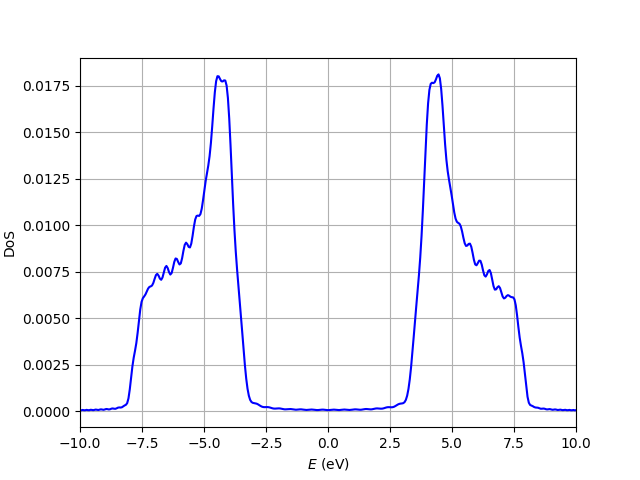
Note that this script will take some seconds to execute since we are considering a system with hundreds of atoms. The density of states is:
Note
For the KPM, the Hamiltonian should be stored in a sparse matrix as it allows faster computation. This can be specified before the Hamiltonian
is computed, setting the attribute tightbinder.system.System.matrix_type to 'sparse'. If the Hamiltonian is stored as a dense matrix
(default behaviour), then a warning message will appear informing of the slower performance.
Warning
The density of states obtained with the KPM is not normalized as it can be checked from the output of the script. The user should normalize
the density of states after it has been obtained setting its integral to the number of states of the system (dimension of the Hamiltonian).
This can be done for instance with the np.trapz routine from NumPy.